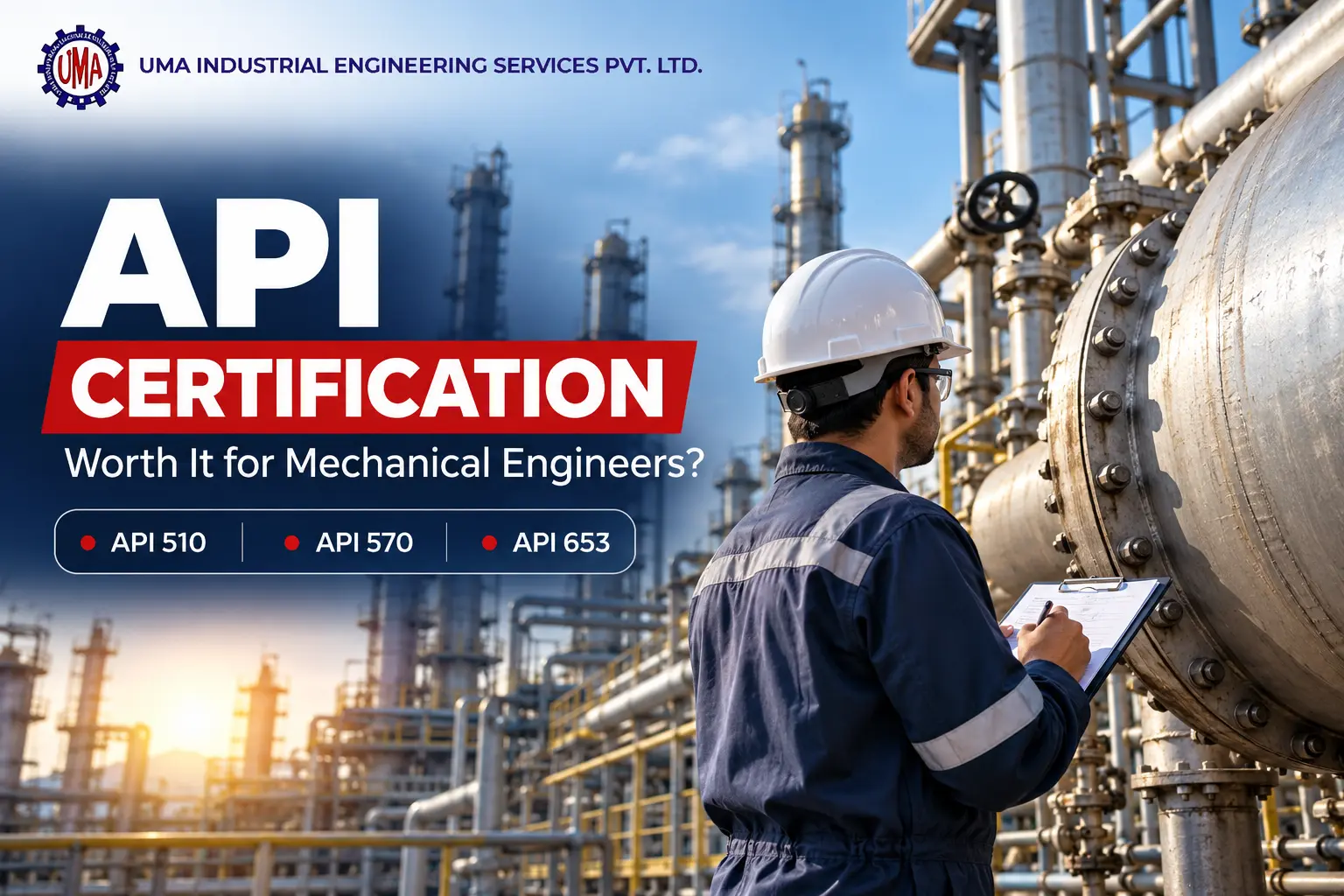
Is API Certification Worth It for Mechanical Engineers?
For many mechanical engineers, the next career step is not necessarily another degree. Sometimes, a professional certification can help them specialize in a particular field and develop the knowledge required for more advanced roles.
This is where API certification often comes into the conversation.
Certifications such as API 510, API 570, and API 653 are closely associated with inspection and mechanical integrity work involving pressure vessels, piping systems, and aboveground storage tanks.
But is API certification actually worth pursuing for a mechanical engineer?
The answer depends on your experience, career goals, industry, and the type of inspection role you want to pursue.
What Is API Certification?
API certification is offered by the American Petroleum Institute (API) through its Individual Certification Programs (ICP). These programs assess whether professionals meet the qualification requirements and demonstrate the knowledge needed for specific inspection-related roles.
For mechanical engineers, three commonly considered certifications are:
- API 510 – Pressure Vessel Inspector: Focuses on pressure vessel inspection, repair, alteration, and related requirements.
- API 570 – Piping Inspector: Covers the inspection, maintenance, alteration, and repair of in-service metallic piping systems.
- API 653 – Aboveground Storage Tank Inspector: Focuses on the inspection, repair, alteration, and reconstruction of aboveground storage tanks.
Each certification addresses a specific area of inspection and mechanical integrity, making it important to choose the one that aligns with your career direction.
Why Are Mechanical Engineers Interested in API Certification?
Mechanical engineering provides a strong foundation in materials, fabrication, welding, maintenance, and industrial equipment. However, inspection roles often require more specialized knowledge of industry codes, equipment condition assessment, and mechanical integrity.
Professionals working in inspection may need to understand:
- Inspection codes and industry standards
- Corrosion and material degradation
- Equipment condition assessment
- Inspection intervals and remaining service life
- Repair and alteration requirements
- Welding and fabrication considerations
- Mechanical integrity and technical documentation
API certification preparation can help engineers develop and demonstrate knowledge in a specific inspection discipline.
For example, API 510 covers technical concepts such as corrosion rates, remaining service life, inspection intervals, and weld joint efficiencies.
API 510 vs. API 570 vs. API 653: Which Is Best for Mechanical Engineers?
There is no single API certification that suits every mechanical engineer. Your choice should depend on the equipment you want to work with and the responsibilities you want to take on.
1. API 510 – Pressure Vessel Inspection
API 510 is relevant to engineers interested in pressure vessel inspection and mechanical integrity.
It may be suitable for professionals working with pressure equipment in industries such as oil and gas, refining, petrochemicals, and process manufacturing.
Candidates must meet API’s education and qualifying experience requirements. For example, applicants with a bachelor’s degree or higher in engineering or technology generally need at least one year of qualifying experience involving the supervision or performance of inspection activities.
2. API 570 – Piping Inspection
API 570 is a relevant option for mechanical engineers who want to specialize in process piping inspection.
The certification focuses on in-service metallic piping systems, including their inspection, maintenance, alteration, and repair.
It may be particularly useful for professionals working in refineries, petrochemical facilities, and industrial plants where piping integrity and reliability are essential.
As with API 510, candidates must meet the applicable education and experience requirements.
3. API 653 – Aboveground Storage Tank Inspection
API 653 focuses on aboveground storage tanks, including their inspection, repair, alteration, and reconstruction.
It may be worth considering for mechanical engineers working around tank farms, petroleum terminals, refineries, and industrial storage facilities.
Candidates must meet the education and relevant experience requirements specified for the program.
Quick guide:
- Interested in pressure vessels? Consider API 510.
- Interested in process piping? Consider API 570.
- Interested in aboveground storage tanks? Consider API 653.
Before applying, always verify the latest eligibility criteria directly with API.
Is API Certification Suitable for Fresh Mechanical Engineering Graduates?
Fresh graduates should approach API certification with a clear understanding of its eligibility requirements.
API certification should not automatically be treated as a beginner-level course that guarantees an inspection job. The relevant programs require qualifying experience, and applicants must document their experience according to the applicable requirements.
A practical career pathway may look like this:
Mechanical Engineering Fundamentals → Technical Training → Relevant Industrial Experience → API Certification
For someone starting their career, developing foundational knowledge in NDT, QA/QC, welding inspection, mechanical inspection, and industrial standards can be a useful step toward a future inspection role.
The right starting point depends on your education, practical exposure, and long-term career objectives.
What Can You Learn Through an API Certification Preparation Program?
API certification preparation involves more than memorizing examination questions. Candidates need to understand technical concepts, interpret applicable standards, perform relevant calculations, and apply inspection requirements to practical situations.
Depending on the program, preparation may cover:
- Corrosion calculations and remaining service life
- Inspection methods and intervals
- Pressure vessel, piping, or tank inspection requirements
- Welding-related requirements
- Applicable codes and standards
- Equipment repair and alteration
- Technical documentation and inspection practices
API examinations include open-book and closed-book portions, depending on the applicable program and current examination rules.
This makes it important to develop a strong understanding of the relevant publications and learn how to apply them correctly.
Does API Certification Guarantee a Higher Salary?
API certification does not guarantee a particular salary, job title, or employment opportunity.
Career outcomes depend on several factors, including:
- Relevant engineering and inspection experience
- Industry and employer requirements
- Job location
- Technical knowledge and practical skills
- Types of equipment and projects handled
- Additional qualifications and certifications
For this reason, it is better to view API certification as a professional specialization that can complement your existing experience rather than as a guaranteed salary upgrade.
Its value is often closely connected to how well the certification matches your role, experience, and career goals.
What Is the Difference Between API Training and API Certification?
Understanding the difference between training and certification is essential before enrolling in a program.
API training helps candidates understand the technical subject, learn relevant standards, and prepare for the examination.
API certification is a formal credential administered by the American Petroleum Institute through its Individual Certification Programs. Candidates must satisfy the applicable eligibility, examination, and recertification requirements.
API ICP certifications generally have a three-year certification term, although the specific requirements depend on the program. API 510, API 570, and API 653 also have continuing professional development and applicable inspection experience requirements for recertification.
Therefore, engineers should consider API certification as part of an ongoing professional development pathway rather than a one-time training certificate.
Who Should Consider API Certification?
API certification may be worth exploring if you are a mechanical engineer who:
- Wants to move into inspection or mechanical integrity.
- Works with pressure vessels, process piping, or storage tanks.
- Has relevant industrial experience.
- Wants to specialize in the petroleum or petrochemical sector.
- Is interested in inspection engineering opportunities.
- Wants to develop a stronger understanding of industry codes and standards.
However, if your career is focused on product design, manufacturing design, thermal engineering, or another mechanical discipline unrelated to inspection, an API certification may not directly support your current goals.
The important question is not simply, “Is API certification worth it?”
It is: “Does API certification align with the career I want to build?”
How Should a Mechanical Engineer Prepare for API Certification?
A structured approach can help you prepare more effectively.
Step 1: Strengthen Your Mechanical Engineering Fundamentals
Build a solid understanding of materials, welding, fabrication, industrial equipment, and basic inspection principles.
Step 2: Gain Relevant Industrial Experience
Practical exposure is important because API certification eligibility depends on the qualifying experience required for the specific program.
Step 3: Understand Inspection Codes and Standards
Become familiar with technical codes, standards, specifications, inspection procedures, and the relevant industry publications.
Step 4: Choose the Right API Certification
Select the program according to your preferred inspection discipline:
- Pressure vessels – API 510
- Process piping – API 570
- Aboveground storage tanks – API 653
Step 5: Prepare Using the Current Examination Requirements
Review the latest API Body of Knowledge, eligibility criteria, examination structure, and applicable publications before beginning your preparation.
Why Choose UMA Industrial for API Training?
UMA Industrial Engineering Services Pvt. Ltd. provides industry-focused training designed to help professionals develop technical knowledge in inspection, NDT, and QA/QC.
Its training portfolio includes:
- API 510, API 570, and API 653 preparation
- NDT Level 2 training
- PAUT and TOFD training
- CSWIP and BGAS preparatory courses
- QA/QC and Lead Auditor training
For mechanical engineers planning to enter or advance in inspection, the goal should be to combine engineering fundamentals, practical inspection knowledge, relevant industrial experience, and the right professional certification.
Choosing the appropriate training pathway can help you prepare more systematically for your next career step.
Final Thoughts: Is API Certification Worth It for Mechanical Engineers?
Yes, API certification can be worth considering for mechanical engineers who want to specialize in inspection, mechanical integrity, pressure equipment, process piping, or aboveground storage tanks.
However, it should not be viewed as a shortcut to employment or a guaranteed salary increase.
Its value depends on your experience, career direction, eligibility, and ability to apply technical knowledge in real industrial environments.
Start by strengthening your technical foundation, gaining relevant experience, understanding inspection standards, and choosing the API certification that best fits your professional goals.
Start Your API Certification Journey with UMA Industrial
Looking to develop your expertise in API 510, API 570, or API 653?
Explore API training with UMA Industrial Engineering Services Pvt. Ltd. and take the next step toward building your inspection knowledge.
Call: +91 97277 44503
Email: [email protected]
Website: www.umaindustrialengineeringservices.com