

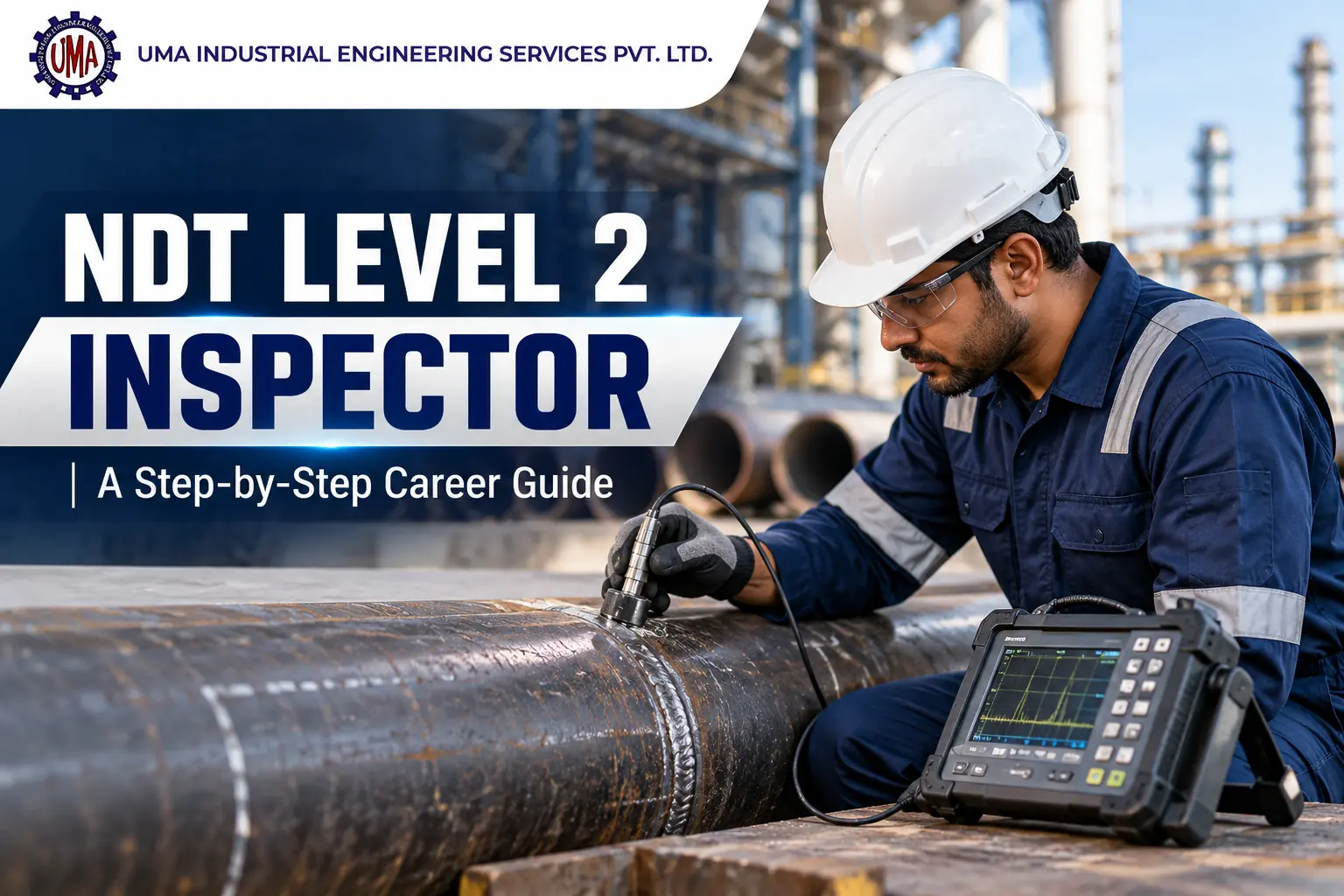
How to Become an NDT Level 2 Inspector: Step-by-Step Career Guide
If you are planning a career in Non-Destructive Testing (NDT), becoming an NDT Level 2 Inspector is an important step toward taking on greater responsibility in industrial inspection.
An NDT Level 2 professional is generally expected to perform inspections, interpret results, and prepare reports with greater independence than an entry-level technician. However, the exact qualification requirements depend on the certification scheme, NDT method, employer, and applicable standards.
For example, ISO 9712:2021 establishes requirements for the qualification and certification of personnel performing industrial NDT across methods such as ultrasonic testing, radiographic testing, magnetic testing, penetrant testing, eddy current testing, and visual testing.
So, how can you become an NDT Level 2 Inspector?
Let’s understand the process step by step.
What Does an NDT Level 2 Inspector Do?
An NDT Level 2 Inspector performs inspection activities using one or more qualified NDT methods. Depending on the certification scheme and scope of qualification, responsibilities may include:
- Setting up and calibrating inspection equipment
- Performing NDT examinations
- Following approved inspection procedures
- Detecting and evaluating indications
- Interpreting inspection results
- Preparing inspection reports
- Understanding relevant codes and specifications
- Supporting quality control and inspection activities
- Guiding junior or trainee personnel where permitted
Level 2 professionals play an important role in maintaining inspection quality, identifying material discontinuities, and ensuring that inspection results are properly documented.
Step 1: Choose Your NDT Method
The first step is to decide which NDT method you want to specialize in. Your choice should depend on your career goals, target industry, and the type of inspection work you want to perform.
Common NDT Methods
1. Ultrasonic Testing (UT)
Uses high-frequency sound waves to examine materials and identify internal discontinuities.
2. Magnetic Particle Testing (MT)
Detects relevant surface and near-surface indications in suitable ferromagnetic materials.
3. Liquid Penetrant Testing (PT)
Identifies surface-breaking discontinuities using a penetrant applied to the component’s surface.
4. Radiographic Testing (RT)
Uses X-rays or gamma radiation to examine internal features and discontinuities in components.
5. Visual Testing (VT)
Uses direct or remote visual examination techniques to identify visible defects and other relevant conditions.
6. Eddy Current Testing (ET)
Uses electromagnetic principles to examine suitable electrically conductive materials.
These methods are used across industries such as oil and gas, power generation, manufacturing, petrochemicals, construction, and infrastructure.
If you are starting your career, choose a method based on the opportunities you want to pursue rather than simply selecting the course with the shortest training duration.
Step 2: Complete the Required NDT Training
After selecting your preferred method, the next step is to complete structured NDT training.
A good training program should cover both theoretical knowledge and practical inspection techniques.
Your training may include:
- Basic NDT principles and terminology
- Equipment and accessories
- Inspection techniques and procedures
- Equipment calibration
- Material properties and discontinuities
- Relevant codes and standards
- Evaluation of indications
- Inspection documentation and reporting
- Practical exercises
Training duration varies according to the NDT method and certification scheme.
For example, ASNT’s 9712 Level II pathway specifies method-specific training requirements, including 18 days for UT and 5 days for MT/PT under its listed requirements. These durations should not be assumed to apply to every certification scheme.
Before enrolling in a course, verify the training requirements of the specific certification you intend to pursue.
Step 3: Gain Practical Experience
Completing a training course is an important milestone, but practical experience is equally important for developing inspection competence.
Working under qualified supervision helps you become familiar with real industrial inspection conditions, equipment handling, calibration, inspection procedures, and reporting.
During your practical experience, focus on developing skills in:
- Handling and operating inspection equipment
- Performing inspections according to approved procedures
- Understanding material conditions and weld inspection
- Recognizing and evaluating indications
- Following safety requirements
- Recording inspection results accurately
- Preparing technical reports
Many certification schemes require documented industrial experience before certification. Maintain your training certificates, experience records, inspection logs, and other relevant documentation.
The required experience depends on the certification scheme, selected method, and applicable requirements.
Step 4: Understand the Certification Requirements
There is no single universal NDT Level 2 certificate with identical requirements across every certification system.
Different organizations and certification schemes may have different eligibility criteria, training requirements, experience requirements, and examination procedures.
For example, ASNT offers different certification pathways, including ASNT NDT Level II and ASNT 9712 Level II, each with its own applicable requirements.
Before choosing a course, verify the following:
- Certification scheme: Identify the qualification or certification you want to pursue.
- NDT method: Select the method relevant to your career goals.
- Training requirement: Confirm the required training hours or days.
- Experience requirement: Check the necessary documented work experience.
- Examination: Understand the required written and practical assessments.
- Certification: Confirm the eligibility and certification process.
Understanding these requirements in advance can help you select an appropriate training pathway and avoid confusion later.
Step 5: Prepare for the NDT Level 2 Examination
Once you meet the applicable eligibility requirements, you can prepare for the required examination.
Depending on the certification scheme, examinations may assess:
- General NDT principles
- Method-specific technical knowledge
- Equipment operation and calibration
- Inspection procedures and techniques
- Materials and discontinuities
- Relevant codes and standards
- Interpretation and evaluation of indications
- Inspection reporting
- Practical inspection skills
For example, ASNT’s 9712 Level II examination structure includes general and specific examinations, instruction preparation, and practical assessment.
Effective preparation involves more than memorizing questions. You should understand how each inspection method works, why a particular technique is selected, and how results are evaluated against the applicable acceptance criteria.
Practical training and a clear understanding of the subject can help you approach examinations with greater confidence.
Step 6: Build Your Career as an NDT Level 2 Inspector
After obtaining the appropriate qualification or certification, your next objective is to develop industry experience and strengthen your technical skills.
Depending on your certification, experience, and employer requirements, you may explore roles such as:
- NDT Technician
- NDT Level 2 Inspector
- Ultrasonic Testing (UT) Inspector
- Magnetic Particle Testing (MT) Inspector
- Penetrant Testing (PT) Inspector
- QA/QC Inspector
- Third-Party Inspection professional
- Shutdown Inspection professional
You may also develop expertise in advanced techniques such as Phased Array Ultrasonic Testing (PAUT) and Time of Flight Diffraction (TOFD).
With additional training, experience, and the necessary qualifications, you may progress toward Level 3 responsibilities, supervision, technical management, or specialized inspection roles.
Career progression depends on industry demand, certification requirements, practical competence, and professional experience.
Skills That Can Help You Become a Better NDT Inspector
Technical certification is important, but successful inspection work also requires practical and professional skills.
Focus on developing the following:
- Attention to detail
- Equipment handling and calibration
- Defect and indication identification
- Technical report writing
- Drawing interpretation
- Knowledge of materials
- Understanding of codes and standards
- Workplace safety awareness
- Communication skills
- Problem-solving ability
A competent NDT Inspector should understand the relationship between the inspection procedure, equipment, observed indications, and applicable acceptance criteria.
Why Choose UMA Industrial for NDT Training?
UMA Industrial Engineering Services Pvt. Ltd. offers industry-focused training opportunities for professionals who want to strengthen their NDT knowledge and practical inspection skills.
Training areas include:
- NDT Level 2 Training
- PCN NDT UT Level II
- CSWIP 3.1 and 3.2 Preparatory Courses
- PAUT Training
- TOFD Training
- ACFM Training
- Eddy Current Testing
Whether you are starting your NDT career or planning to develop additional technical skills, selecting the right training program is an important step toward your professional goals.
Contact UMA Industrial to understand the available courses and identify a suitable training pathway based on your career objectives and intended certification scheme.
Final Thoughts
Becoming an NDT Level 2 Inspector involves more than completing a training course. It requires a combination of technical knowledge, practical experience, examination preparation, and meeting the applicable certification requirements.
The overall pathway can be summarized as:
Choose an NDT Method → Complete Training → Gain Practical Experience → Meet Certification Requirements → Pass the Examination → Develop Your Career
Since requirements differ between certification schemes, always verify the applicable criteria before beginning your training.
If you are serious about building a career in Non-Destructive Testing, start by strengthening your fundamentals, selecting a suitable method, and gaining relevant practical experience.
Start Your NDT Journey with UMA Industrial
Looking for NDT Level 2 training in Surat?
Connect with UMA Industrial Engineering Services Pvt. Ltd. to explore industry-focused NDT training and certification-oriented programs.
Call: +91 97277 44503
Website: www.umaindustrialengineeringservices.com
Email: [email protected]
Train. Certify. Grow with UMA Industrial.
Frequently Asked Questions (FAQs)
1. What is an NDT Level 2 Inspector?
An NDT Level 2 Inspector is a qualified or certified professional who can perform inspection activities, interpret results, and prepare reports within the scope of their qualification and applicable certification requirements.
2. How do I become an NDT Level 2 Inspector?
The typical pathway involves selecting an NDT method, completing the required training, gaining the necessary practical experience, meeting the certification body’s eligibility criteria, and passing the applicable examinations.
3. Is experience required for NDT Level 2?
Many certification schemes require documented practical experience. The amount of experience depends on the selected NDT method and certification scheme.
4. Which NDT method should I learn first?
Common methods include UT, MT, PT, RT, VT, and ET. Your choice should depend on your technical background, career objectives, target industry, and employer requirements.
5. Can I become an NDT Level 2 Inspector after training?
Training alone may not be sufficient. Depending on the certification scheme, you may also need documented practical experience and successful completion of the required examinations.
6. What can I do after NDT Level 2?
Depending on your qualification and experience, you can pursue NDT inspection roles, develop additional methods, learn advanced techniques such as PAUT and TOFD, or work toward higher-level technical responsibilities.