

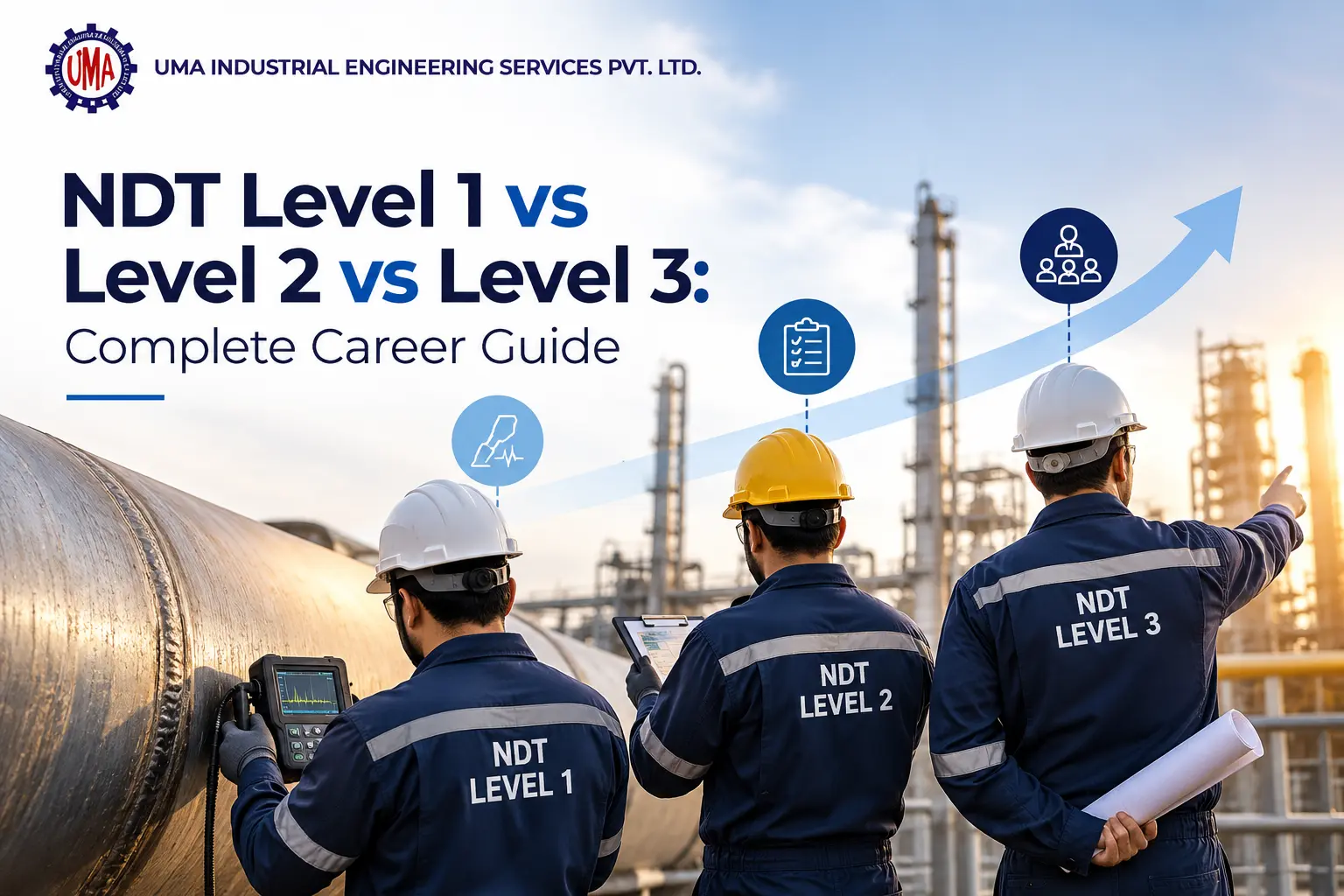
NDT Level 1 vs Level 2 vs Level 3: Complete Career Guide
Non-Destructive Testing (NDT) is an important part of industries where materials, welds,
components, and equipment need to be inspected without causing damage. From oil and gas
and fabrication to power, aerospace, and infrastructure, NDT professionals help identify defects
and support safe, reliable operations.
If you are planning a career in NDT, one of the first things you will come across is NDT Level 1,
Level 2, and Level 3. These levels represent different stages of technical responsibility,
knowledge, experience, and decision-making.
Understanding the difference between them can help you choose the right training path for your
career.
What Are NDT Levels?
NDT certification levels generally indicate the scope of an individual’s training, practical skills,
responsibilities, and authority within a particular NDT method.
The three commonly discussed levels are:
● NDT Level 1: Performs specific inspection tasks under supervision.
● NDT Level 2: Performs and interprets inspections independently within the applicable
scope.
● NDT Level 3: Handles advanced technical responsibilities, procedures, interpretation,
and technical oversight.
The exact requirements can vary depending on the NDT method, certification scheme,
applicable standard, employer, and industry.
NDT Level 1: Where Your NDT Career Begins
NDT Level 1 is generally considered an entry-level qualification for professionals starting in
non-destructive testing.
A Level 1 technician is trained to carry out specific inspection tasks according to established
instructions and procedures. The work is typically performed under the supervision of a Level 2
or Level 3 professional.
Depending on the method, Level 1 training may introduce you to equipment operation, test
preparation, basic inspection techniques, safety requirements, and recording results.
What Does an NDT Level 1 Technician Do?
Typical responsibilities can include:
● Preparing components for inspection
● Setting up NDT equipment
● Carrying out specific testing activities
● Following approved procedures
● Recording inspection observations
● Maintaining basic inspection documentation
● Working under appropriate supervision
For someone completely new to NDT inspection, Level 1 can provide a practical starting point
for understanding how inspection work is carried out in real industrial environments.
NDT Level 2: Building Independent Inspection Skills
NDT Level 2 is an important stage for professionals who want to develop stronger technical and
inspection responsibilities.
A Level 2 professional generally has greater responsibility for performing examinations,
interpreting results, and determining whether indications meet the applicable acceptance criteria
within their certification scope.
Level 2 training can cover both theoretical concepts and practical application of a specific NDT
method.
Depending on the method, professionals may work with techniques such as:
● Ultrasonic Testing (UT)
● Magnetic Testing (MT)
● Penetrant Testing (PT)
● Visual Testing (VT)
● Eddy Current Testing (ET)
● Radiographic Testing (RT)
Advanced methods such as PAUT and TOFD can provide further specialization for
professionals working in advanced inspection applications.
What Does an NDT Level 2 Technician Do?
A Level 2 professional may be responsible for:
● Selecting appropriate testing techniques within their scope
● Setting up and calibrating equipment
● Performing inspections
● Interpreting indications
● Evaluating results against applicable requirements
● Preparing inspection reports
● Guiding Level 1 personnel where applicable
For many people entering the NDT profession, Level 2 training and certification becomes an
important career-development milestone.
NDT Level 3: Advanced Technical Responsibility
NDT Level 3 represents a more advanced stage of technical expertise.
Level 3 professionals are typically involved in technical and procedural responsibilities rather
than only carrying out routine inspections. Their work can involve developing or approving
procedures, interpreting complex requirements, providing technical guidance, and supporting
the qualification or training of NDT personnel.
Responsibilities may include:
● Developing and reviewing NDT procedures
● Providing technical guidance
● Selecting appropriate NDT techniques
● Evaluating complex inspection requirements
● Supporting method development
● Interpreting applicable standards and specifications
● Training or supervising NDT personnel
● Providing technical oversight
The role of a Level 3 NDT professional can therefore extend beyond field inspection into
engineering, technical management, procedure development, and consultancy.
NDT Level 1 vs Level 2 vs Level 3
Factor NDT Level 1 NDT Level 2 NDT Level 3
Career stage Entry-level Intermediate/experienced Advanced
Main focus Performing
assigned tasks
Testing & interpretation Technical oversight
Supervision Works under
supervision
Greater independence Provides technical
guidance
Procedure
knowledge
Follows
procedures
Understands and applies
procedures
Develops/reviews
procedures
Result
interpretation
Limited Significant responsibility Advanced technical
evaluation
Personnel
guidance
Usually limited May guide Level 1 Can train/supervise
personnel
Career direction Field technician Inspector / specialist Technical expert /
consultant
These are broad distinctions. Actual responsibilities depend on the certification scheme,
method, employer, and applicable industry requirements.
Which NDT Level Should You Choose?
There is no single level that is right for everyone. Your starting point depends on your education,
experience, existing technical skills, and career goals.
If you are completely new to the field, NDT Level 1 can help you understand the fundamentals
and practical inspection environment.
If you already have relevant experience or want to take on greater inspection responsibilities,
NDT Level 2 may be the next stage to explore.
Professionals with substantial experience and technical knowledge can work toward Level 3,
subject to the requirements of the relevant certification scheme.
It is also important to remember that NDT certification is generally method-specific. Being
certified in one NDT method does not automatically mean you are certified in every other
method.
How to Build a Career in NDT
A successful NDT career is not based on certification alone. Practical understanding, safety
awareness, technical knowledge, relevant experience, and continuous learning all matter.
A typical progression can look like:
Learn the Fundamentals → Choose an NDT Method → Get Practical Training → Obtain Relevant Certification → Gain Experience → Develop Advanced Skills
Once you have a strong foundation, you can explore specialized areas such as UT, PAUT, TOFD, ACFM, Eddy Current Testing, CSWIP, BGAS, QA/QC, and other inspection
disciplines, depending on your career goals.
Why Choose UMA Industrial for NDT Training?
At Uma Industrial Engineering Services Pvt. Ltd., professionals and aspiring inspectors can
explore industry-focused training in areas such as NDT Level 2, UT, PAUT, TOFD, ACFM,
Eddy Current Testing, CSWIP, BGAS, QA/QC, API, and Lead Auditor training.
The focus is on developing technical knowledge that connects with real industrial inspection
requirements.
For anyone planning to build a career in NDT and industrial inspection, choosing the right
training and certification path is an important first step.
Final Thoughts
NDT offers different career paths depending on your technical interests, experience, and
long-term goals. Level 1, Level 2, and Level 3 are not simply higher certificates—they
represent increasing levels of technical responsibility and expertise.
Before choosing a course, understand the certification requirements, applicable NDT method,
training prerequisites, and the type of work you want to pursue.
With the right combination of training, certification, practical exposure, and continuous
learning, you can build a strong foundation for a career in NDT and industrial inspection.
Build Your NDT Career with UMA Industrial
Looking to develop your NDT skills?
Explore NDT training and certification programs with Uma Industrial Engineering Services Pvt. Ltd.
�� 9727744503
�� [email protected]
FAQs
1. What is the difference between NDT Level 1 and Level 2?
Level 1 generally performs defined inspection tasks under supervision, while Level 2 typically
has greater responsibility for performing examinations, interpreting results, and evaluating
indications within their certification scope.
2. Is NDT Level 2 suitable for beginners?
Eligibility and prerequisites depend on the certification scheme and method. Candidates should
check the applicable requirements before enrolling.
3. What does an NDT Level 3 professional do?
Level 3 professionals generally handle advanced technical responsibilities such as procedure
development or review, technical guidance, and complex inspection requirements.
4. Can I learn multiple NDT methods?
Yes. Professionals can pursue certification in multiple methods, provided they meet the
applicable training, experience, examination, and certification requirements.
5. Which NDT method should I learn first?
It depends on your career goals, industry interest, existing experience, and the inspection work
you want to pursue. Common methods include UT, MT, PT, VT, ET, and RT.