What Is Ultrasonic Testing in NDT? Methods, Applications & Advantages
Ultrasonic Testing (UT) is one of the most widely used Non-Destructive Testing (NDT) methods for inspecting materials, components, welds, and structures without causing damage. It uses high-frequency sound waves to identify internal flaws that may not be visible during a normal visual inspection.
For industries such as oil and gas, power generation, petrochemicals, manufacturing, construction, and fabrication, ultrasonic testing in NDT plays an important role in maintaining safety, quality, and reliability.
What Is Ultrasonic Testing?
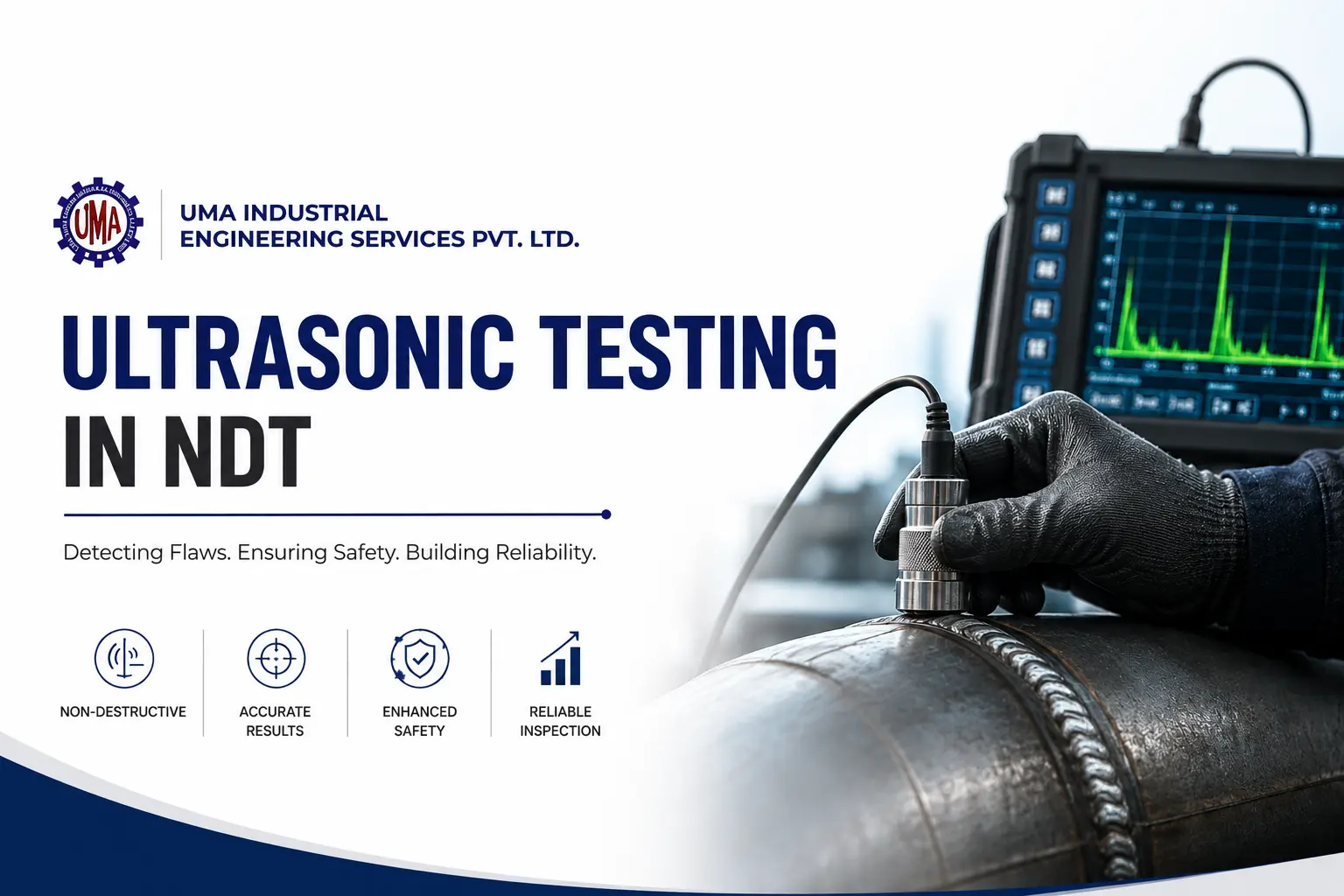
Ultrasonic Testing is an NDT technique that uses high-frequency ultrasonic sound waves to examine the internal condition of a material. A probe, also called a transducer, sends sound waves into the component. When these waves encounter a boundary, defect, or change in material structure, part of the energy is reflected back to the probe.
The returned signals are displayed and interpreted by a trained NDT professional to determine the location, size, and nature of possible discontinuities.
Unlike destructive testing, UT allows components to be inspected while keeping them suitable for further use.
How Does Ultrasonic Testing Work?
The basic ultrasonic testing process involves placing a suitable transducer on the surface of the test component. A couplant is generally applied between the probe and surface to help transmit sound waves effectively.
The ultrasonic waves travel through the material and interact with internal features. If a crack, void, lack of fusion, inclusion, or other discontinuity is present, it can produce a reflected signal.
The technician or inspector analyzes the signal and evaluates the indication according to applicable inspection procedures and standards.
Common Ultrasonic Testing Methods
Different UT methods are used depending on the component, material, and inspection requirement.
1. Ultrasonic Thickness Measurement
This method measures the thickness of materials such as pipes, tanks, pressure vessels, and plates. It is particularly useful for identifying material loss caused by corrosion or erosion.
2. Ultrasonic Flaw Detection
This method is used to detect internal discontinuities such as cracks, porosity, inclusions, and welding defects. It is commonly applied to welds and critical components.
3. Phased Array Ultrasonic Testing (PAUT)
PAUT uses multiple ultrasonic elements that can be electronically controlled to produce different beam angles. It provides detailed inspection and imaging capabilities and is widely used for weld and structural inspections.
4. Time of Flight Diffraction (TOFD)
TOFD is an advanced ultrasonic technique used primarily for accurate detection and sizing of defects in welds. It can provide valuable information about the height and position of a discontinuity.
Applications of Ultrasonic Testing
Ultrasonic testing applications cover a wide range of industries. Common uses include:
- Weld inspection in pipelines and pressure vessels
- Corrosion and thickness monitoring
- Inspection of steel plates, pipes, and forgings
- Detection of internal cracks and discontinuities
- Quality control during manufacturing and fabrication
- Inspection of critical industrial components
- Maintenance and reliability programs
Advantages of Ultrasonic Testing
There are several important advantages of ultrasonic testing in NDT, including:
- Detects internal defects that may not be visible externally
- Does not damage or destroy the component
- Provides accurate information about defect location
- Can measure material thickness
- Suitable for many metals and industrial components
- Supports preventive maintenance and quality control
- Advanced techniques such as PAUT and TOFD provide detailed inspection results
Why Proper NDT Training Matters
The accuracy of an ultrasonic inspection depends greatly on the knowledge and skill of the inspector. Proper NDT training and certification help professionals understand equipment, inspection procedures, applicable standards, defect evaluation, and reporting requirements.
For professionals looking to build a career in NDT, learning conventional UT along with advanced methods such as PAUT and TOFD can provide valuable technical expertise for industrial inspection roles.
FAQs About Ultrasonic Testing
Is ultrasonic testing a non-destructive test?
Yes. Ultrasonic Testing is a Non-Destructive Testing method, meaning the component can generally continue to be used after inspection.
What defects can ultrasonic testing detect?
UT can detect various internal discontinuities, including cracks, lack of fusion, inclusions, voids, and other material or welding defects.
Where is ultrasonic testing commonly used?
UT is widely used in industries such as oil and gas, petrochemical, power, manufacturing, fabrication, construction, and pipeline inspection.
What is the difference between UT, PAUT, and TOFD?
UT is the broader ultrasonic testing method. PAUT uses multiple electronically controlled elements for advanced beam scanning, while TOFD uses diffracted signals to detect and size defects, particularly in welds.
Is NDT certification important for an ultrasonic testing career?
Yes. Relevant NDT training and certification can help professionals demonstrate their technical knowledge and qualify for inspection roles according to industry requirements.