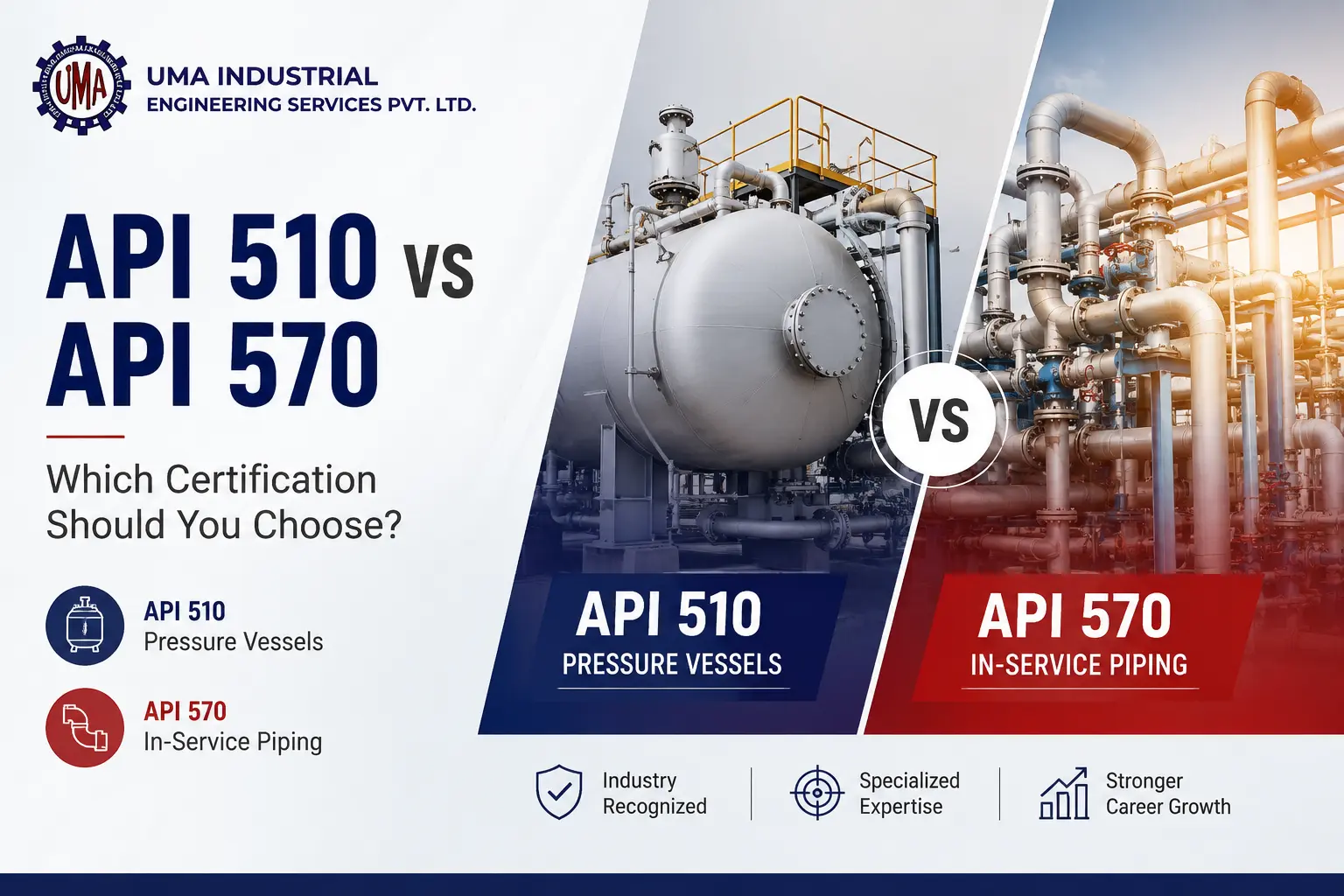
API 510 vs API 570: Which Certification Should You Choose?
In the oil and gas, petrochemical, chemical, and process industries, equipment inspection plays an important role in maintaining plant safety and reliability. API 510 and API 570 certifications are two widely recognized credentials for professionals working in inspection and asset integrity. However, they focus on different types of equipment. Choosing the right certification depends on your career goals and practical experience.
What Is API 510 Certification?
API 510 is the Pressure Vessel Inspector certification offered through the American Petroleum Institute (API). It focuses on the inspection, maintenance, repair, alteration, and integrity of pressure vessels used in process industries.
API 510 professionals may work with equipment such as pressure vessels, reactors, separators, heat exchangers, and other pressurized equipment. The certification is particularly suitable for engineers and inspection professionals who want to specialize in pressure vessel inspection and fixed equipment integrity.
What Is API 570 Certification?
API 570 is the Piping Inspector certification designed for professionals involved with in-service metallic piping systems. It covers inspection, repair, alteration, and evaluation of piping used in operating facilities.
API 570 is a good choice for professionals interested in piping inspection, corrosion monitoring, thickness measurements, and piping integrity management. It can be valuable for inspection engineers, quality professionals, and personnel working with plant piping systems.
API 510 vs API 570: Key Difference
The simplest way to understand the difference is:
- API 510 → Pressure Vessels
- API 570 → In-Service Piping
Both certifications require relevant education and industry experience, and both have examination requirements established by API. The current API exam format for both certifications includes closed-book and open-book portions over a 7.5-hour examination session.
| Feature | API 510 | API 570 |
|---|---|---|
| Main Focus | Pressure vessels | Piping systems |
| Suitable For | Vessel inspection professionals | Piping inspection professionals |
| Major Areas | Vessel integrity, inspection, repair | Piping integrity, inspection, repair |
| Industries | Oil & gas, petrochemical, chemical | Oil & gas, petrochemical, chemical |
| Career Direction | Pressure Vessel Inspector | Piping Inspector |
Which Certification Should You Choose?
Your work experience and career objective should guide your decision.
Choose API 510 if you are interested in pressure vessels, fixed equipment inspection, vessel integrity, and maintenance activities.
Choose API 570 if your work is more closely related to process piping, piping inspection, corrosion monitoring, and piping integrity.
For professionals working across both equipment categories, obtaining both API 510 and API 570 certifications can provide broader inspection knowledge and expand career opportunities.
Why API Certification Matters
API certifications demonstrate specialized knowledge of industry inspection practices and are valued across process and energy industries. API’s Individual Certification Program certifications, including API 510 and API 570, are accredited through the relevant personnel-certification accreditation framework.
For candidates, proper preparation is essential because the examinations require both technical understanding and the ability to work with applicable codes, standards, and inspection practices.
Conclusion
There is no single “better” certification between API 510 and API 570. The right choice depends on the equipment you work with and the direction you want your career to take. If your goal is pressure vessel inspection, API 510 is the natural choice. If you want to specialize in piping inspection, API 570 is more suitable.
With structured preparation and practical industry knowledge, professionals can use these certifications to strengthen their expertise and build a career in inspection and asset integrity.
Frequently Asked Questions
1. Is API 510 better than API 570?
Neither is universally better. API 510 focuses on pressure vessels, while API 570 focuses on in-service piping systems.
2. Can I take API 510 and API 570?
Yes. Professionals who meet the respective eligibility requirements can pursue both certifications.
3. Which certification is suitable for a piping inspector?
API 570 is specifically focused on in-service metallic piping systems and is generally the more relevant certification for piping inspection professionals.
4. Which certification is suitable for pressure vessel inspection?
API 510 is designed for pressure vessel inspectors and covers inspection, maintenance, repair, and alteration of pressure vessels.
5. How can I prepare for API 510 or API 570?
Candidates should study the applicable API Body of Knowledge, referenced standards, and examination publications while developing strong practical inspection knowledge.
Looking to prepare for API certifications? Uma Industrial provides professional training designed to help inspection professionals strengthen their technical knowledge and prepare for industry-recognized certification pathways.