

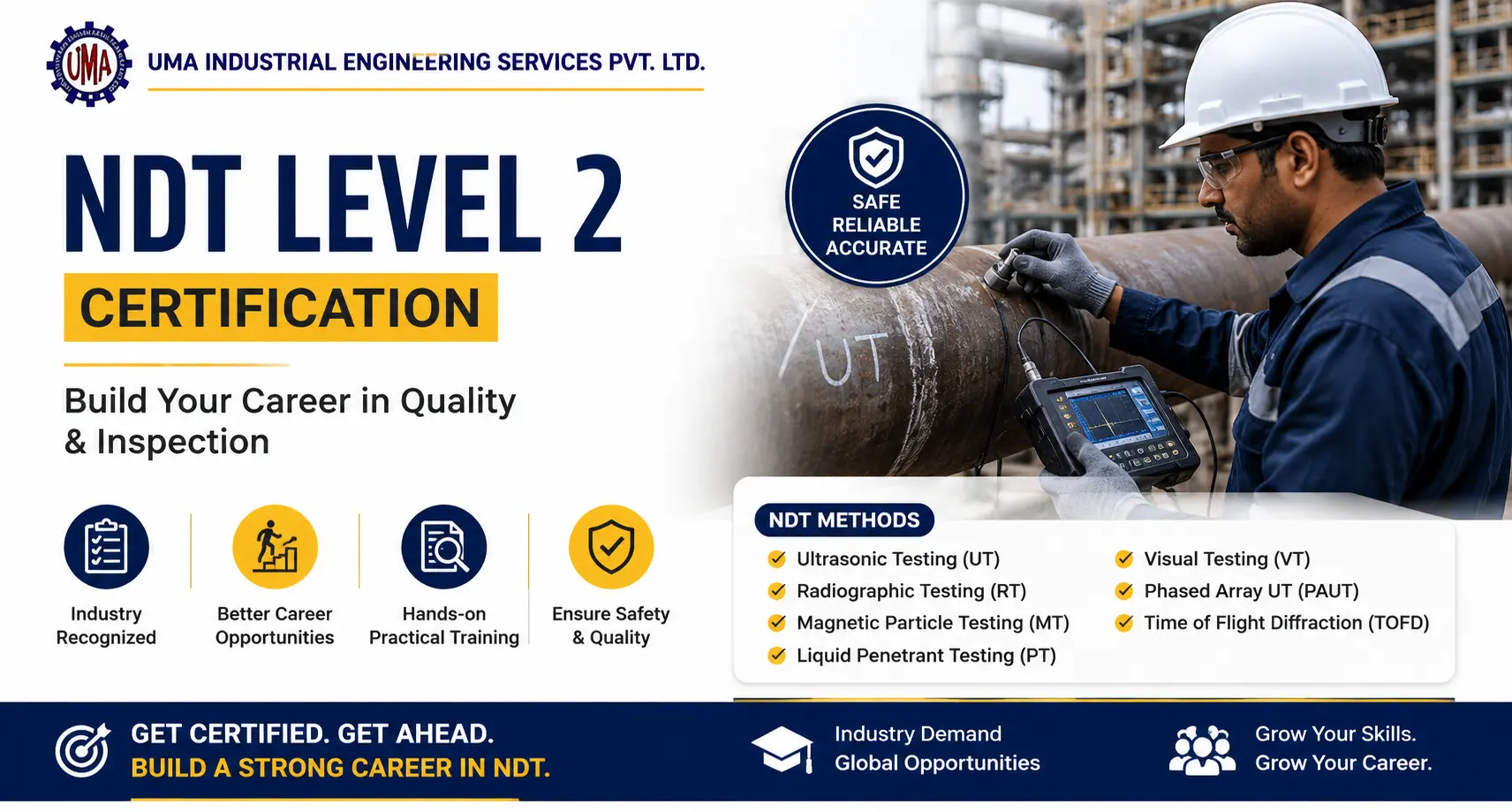
NDT Level 2 Certification: Eligibility, Career Scope & Job Opportunities
Non-Destructive Testing (NDT) is an essential part of quality control in industries where safety, reliability, and product performance are critical. From oil and gas to manufacturing, construction, aerospace, and power generation, NDT professionals help identify defects without damaging the material or component being tested.
Among the different certification levels, NDT Level 2 certification is one of the most valuable qualifications for professionals looking to build a career in inspection and quality control.
What Is NDT Level 2 Certification?
NDT Level 2 certification demonstrates that a professional has the knowledge and practical skills to perform specific non-destructive testing methods, evaluate test results, and prepare inspection reports.
Depending on the training program and industry requirements, professionals can specialize in methods such as:
- Ultrasonic Testing (UT)
- Radiographic Testing (RT)
- Magnetic Particle Testing (MT)
- Liquid Penetrant Testing (PT)
- Visual Testing (VT)
- Phased Array Ultrasonic Testing (PAUT)
- Time of Flight Diffraction (TOFD)
Level 2 professionals generally work independently within the scope of their certification and play an important role in detecting material defects and maintaining quality standards.
NDT Level 2 Eligibility
The eligibility requirements can vary depending on the certification scheme, testing method, and employer. Generally, candidates should have a technical or engineering background, although requirements may differ for individual NDT methods.
Candidates are also required to complete appropriate NDT Level 2 training, gain the required practical experience, and pass the relevant examination.
For professionals already working in mechanical, production, fabrication, welding, inspection, or quality control roles, NDT Level 2 certification can be a useful way to strengthen their technical profile.
Career Scope After NDT Level 2 Certification
The demand for qualified NDT technicians and inspectors continues across industries where components and structures must be inspected for defects.
Career opportunities are available in:
- Oil and gas
- Petrochemical industries
- Power plants
- Refineries
- Aerospace
- Shipbuilding
- Construction
- Automotive manufacturing
- Welding and fabrication
- Engineering and manufacturing
Depending on experience and specialization, an NDT Level 2 professional may work as an NDT Technician, NDT Inspector, Quality Inspector, Welding Inspector, or Testing Technician.
Professionals with specialized skills in advanced methods such as PAUT and TOFD can also explore opportunities in industries where advanced ultrasonic inspection is required.
Job Opportunities and Career Growth
NDT Level 2 certification can open opportunities in both domestic and international markets. Companies involved in manufacturing, fabrication, infrastructure, energy, and industrial inspection regularly require skilled professionals who can perform accurate testing and documentation.
With practical experience, additional certifications, and advanced NDT skills, professionals can progress toward senior inspection and quality-control positions. Continuous learning is particularly important because NDT technologies, standards, and industry requirements continue to evolve.
Why Choose NDT Level 2 Training?
Choosing a reliable NDT training institute is important for developing both theoretical knowledge and practical testing skills. Quality training should cover testing principles, equipment operation, defect identification, safety procedures, reporting, and examination preparation.
For aspiring NDT professionals, the right training can provide a strong foundation for entering the inspection industry and developing a long-term career.
FAQs About NDT Level 2 Certification
1. Is NDT Level 2 a good career option?
Yes. NDT offers career opportunities across manufacturing, oil and gas, power, aerospace, fabrication, and other industrial sectors.
2. Which NDT method is best for a career?
UT, RT, MT, PT, VT, PAUT, and TOFD all have industry applications. The best choice depends on your career goals and target industry.
3. Can beginners pursue NDT Level 2 certification?
Eligibility depends on the certification scheme and method. Candidates should check the specific education, training, and experience requirements before enrolling.
4. What jobs can I get after NDT Level 2?
Common roles include NDT Technician, NDT Inspector, Quality Inspector, and Testing Technician.
5. Is practical training important for NDT Level 2?
Yes. Practical experience is essential for developing equipment-handling, inspection, defect-detection, and reporting skills.